

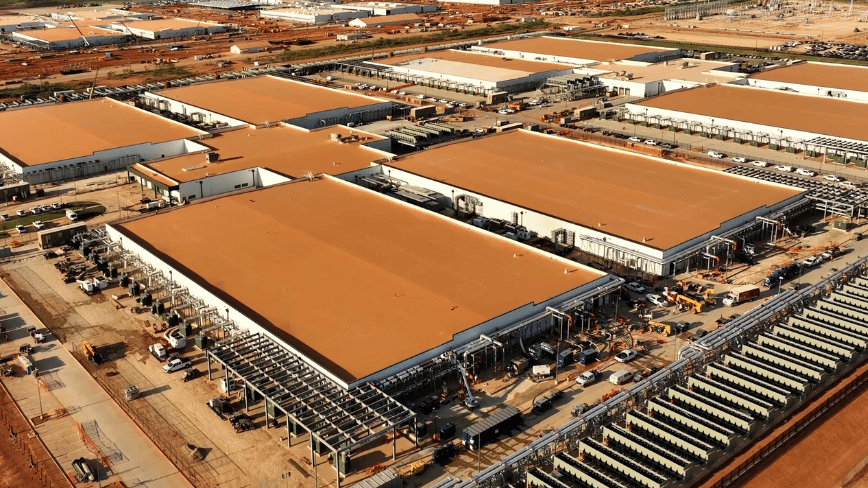
In short: Iran’s Islamic Revolutionary Guard Corps (IRGC) has issued a video threatening "complete and utter annihilation" of OpenAI’s $30bn Stargate AI campus in Abu Dhabi. This unprecedented warning specifically names the facility and comes in response to potential U.S. attacks on Iranian civilian infrastructure.
A senior officer from the IRGC, Brigadier General Ebrahim Zolfaghari, unveiled the threat in a video released on April 3, 2026. The footage begins with a blurred satellite image of the desert site, transitioning to sharp night-vision visuals of the Stargate campus. The message displayed reads: "Nothing stays hidden to our sight, though hidden by Google." This represents a notable escalation in Iran’s stance, as just days prior, the organization had identified 18 U.S. tech companies, including Apple and Microsoft, as legitimate military targets without specifying any particular facility.
Zolfaghari indicated that an attack would be executed if the United States carries out President Donald Trump’s threats to bomb Iranian power plants and desalination facilities. Although the threat is conditional, it follows a month of increased military tensions, including a U.S.-Israel joint campaign that began on February 28, 2026, which has already seen Iranian retaliatory strikes against Gulf energy infrastructure and military sites.
What is Stargate UAE?
Stargate UAE is the international flagship of a $500bn joint venture involving OpenAI, SoftBank, Oracle, and Abu Dhabi's sovereign investment vehicle, MGX. The campus is under construction in the desert south of Abu Dhabi and is being financed by UAE AI company G42. It is designed to be operated collaboratively by OpenAI and Oracle.
The first phase of the facility, featuring a 200-megawatt compute cluster powered by Nvidia Grace Blackwell GB300 systems, is expected to launch by the end of 2026. Once fully operational, the campus aims for a total capacity of 1 gigawatt, with projected costs exceeding $30bn. It is reported to house up to 500,000 Nvidia GPUs, although this figure is yet to be verified. If completed as planned, Stargate UAE would become the largest concentration of AI compute capacity outside the United States.
Key contributions to the project include Cisco providing zero-trust networking infrastructure, Oracle managing cloud operations, and Nvidia supplying chips, while G42 oversees construction and land interests.
A conflict that has already reached the server room
The threat against Stargate is no longer theoretical. On March 1, 2026, Iranian Shahed drones targeted two Amazon Web Services (AWS) data centers in the UAE, disrupting services and knocking two of three availability zones offline for over 24 hours. The attacks affected banking services and other critical platforms across the region, leading AWS to waive usage fees for March.
On April 2, Iran also claimed to have struck an Oracle data center in Dubai, though local media disputed this account. These incidents mark the first recorded instances of a state targeting commercial data centers in an active military campaign, lending credibility to the threats against Stargate.
The stakes for global AI infrastructure
The timing of these threats poses significant challenges for the tech industry. Analysts project hyperscaler capital expenditure will surpass $600bn in 2026, predominantly for AI infrastructure. The Gulf region was previously anticipated to be the fastest-growing data center market globally, but this conflict raises new risks.
Insurers and institutional lenders are reevaluating risk models for Middle Eastern infrastructure, especially as firms aggressively pursue long-term capacity commitments. A successful strike on Stargate could dramatically reshape where future AI compute facilities are established, potentially shifting focus to Northern Europe, India, and Southeast Asia.
One analyst emphasized the dilemma: previously, if U.S. data center development faced obstacles, the industry could rely on Middle Eastern partners. Now, however, the question arises: who would insure a facility in this region vulnerable to drone attacks?
This conflict also intensifies discussions on the intertwined nature of cybersecurity and AI infrastructure. The chief technology officer of Palantir noted that the Iran conflict represents a major war influenced by AI-assisted targeting, where advanced technologies process battlefield data to expedite military decisions. As a result, AI infrastructure, which enhances military capabilities, simultaneously becomes a prime military target.
OpenAI has thus far refrained from publicly addressing the threat. The company is navigating a complex landscape, particularly regarding its partnership with Microsoft, which is developing its own AI models to mitigate reliance on any single partner. The potential destruction or disruption of the Abu Dhabi facility could significantly impact OpenAI's expansion plans outside U.S. borders.
As of April 6, 2026, Iran has not executed its specific threat, and ceasefire negotiations remain stalled. Iran has dismissed a U.S. proposal for a temporary ceasefire while Trump continues to threaten Iranian infrastructure. The $30bn campus in the Abu Dhabi desert now sits at the crossroads of two conflicts: one kinetic, waged with drones and missiles across the Gulf, and the other strategic, centered on who controls the computational power that will drive the next decade of artificial intelligence. The outcome of these tensions may hinge on decisions made in the coming weeks.
Source: TNW | Amazon News